What Does TLDR Mean? Meaning, Origin, and How to Use It Well
TLDR started as a blunt response to overly long internet posts, but today it’s just as often used helpfully: as a label for a short summary that saves the reader time. Knowing which use you’re seeing and how to write a good one yourself matters more than the definition alone.
Who this guide is for: anyone who has seen “TLDR” or “TL;DR” online and wants a clear answer, plus anyone who wants to write a good one themselves.
Last verified: August 2026
Quick Answer
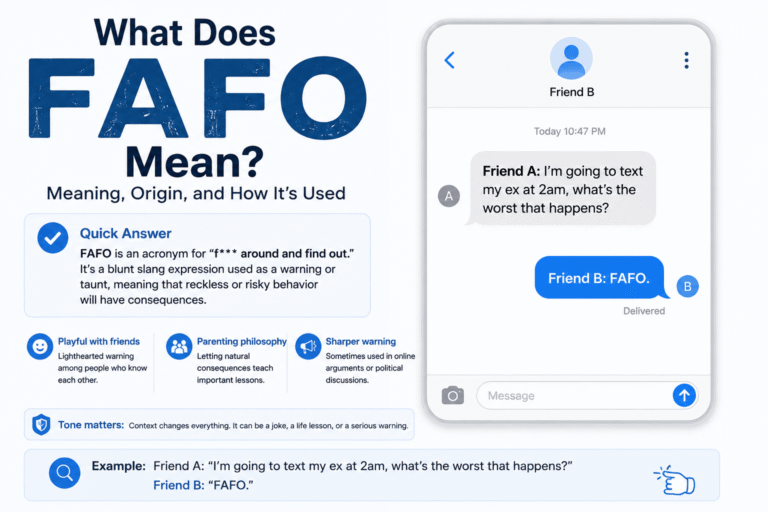
TLDR stands for “too long; didn’t read”. It is used to flag that a piece of text is lengthy, and it usually introduces a short summary so readers can get the main point quickly. Merriam-Webster added TL;DR to its dictionary in 2018 as part of a batch of 840 new entries, listing it as both an interjection and a noun. Its dictionary entry traces the earliest recorded use to 2002.
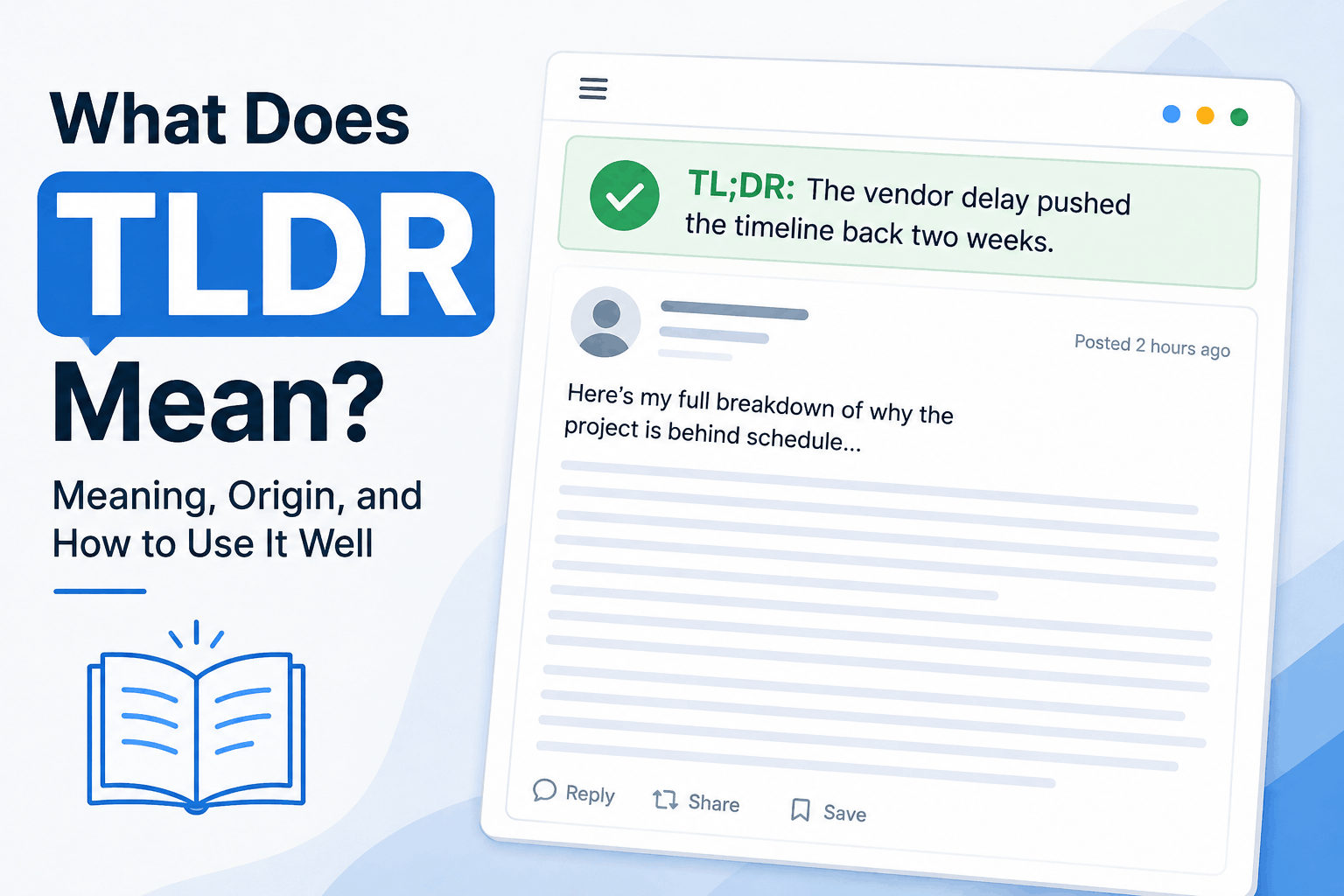
Example: Long post: “Here’s my full breakdown of why the project is behind schedule…” TL;DR: “The vendor delay pushed the timeline back two weeks.”
How We Checked This
We checked the current Merriam-Webster entry directly for the official definition, part of speech, and its own note on earliest recorded use, and cross-checked the specific 2018 dictionary-addition date against news coverage of that update. For the origin story, we relied on How-To Geek’s account, which explicitly treats the exact originating forum as unconfirmed. Other sources name different specific forums, so we present that detail as disputed rather than settled.
TLDR vs Similar Summary Terms
| Term | What it means | Typical setting |
| TLDR / TL;DR | Too long; didn’t read, a short summary of a longer text | Forums, social media, email, blogs |
| BLUF | Bottom line up front, the main point stated first | Military and business writing |
| ELI5 | Explain like I’m 5, a simplified explanation | Reddit and casual online discussion |
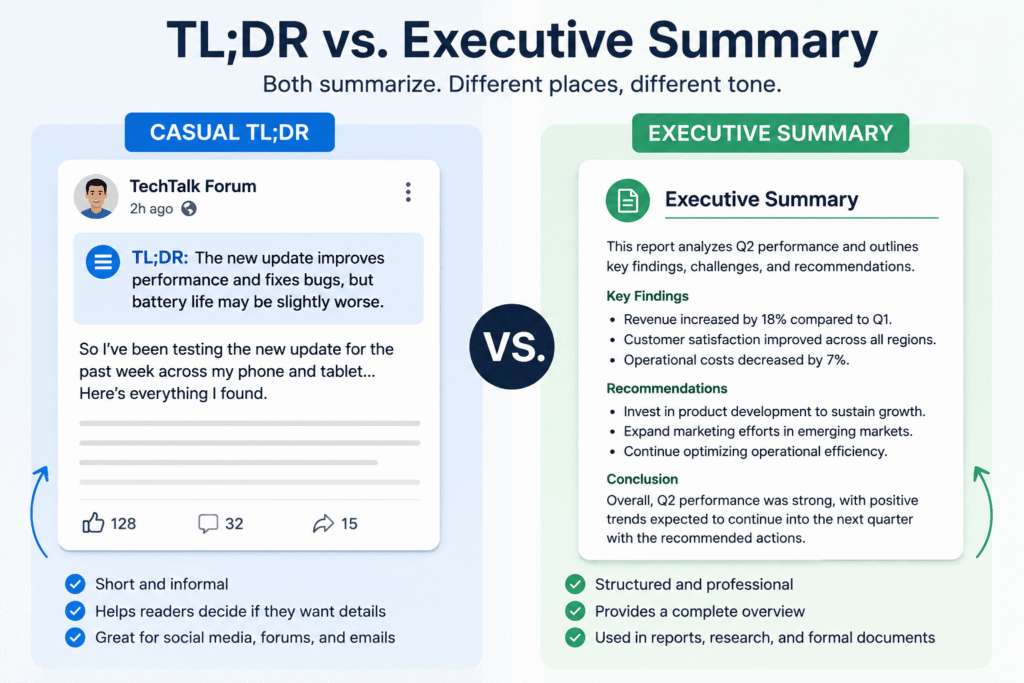
| Executive summary | A formal, structured overview of a report | Business and corporate documents |
| Abstract | A formal summary of a research paper | Academic and scientific writing |
TLDR and BLUF are often confused since both introduce a short summary, but BLUF is generally used in more formal or professional writing, while TLDR stays casual.
Best For, By Situation
- Best for long social media posts or forum threads: a one- to two-sentence TL;DR at the top or bottom, so readers can decide whether to read further.
- Best for emails: a short TL;DR line near the top, useful when the full message covers several points.
- Best for academic or legal writing: skipping TLDR entirely and using a proper abstract or executive summary instead.
- Best for a resume or job application: avoiding the term, since it reads as too casual for formal documents.
Meaning and Spelling
Best for: understanding why you’ll see the term written more than one way.
Why it works: TL;DR is the traditional punctuated form, while TLDR drops the semicolon for easier typing . Both mean exactly the same thing.
Who should skip this: anyone writing for a strict style guide or formal publication, where neither form is typically appropriate.
Practical tip: you’ll commonly see both “TL;DR” and “TLDR” online. The punctuated form reflects the abbreviation’s traditional spelling, while the unpunctuated version is convenient for casual typing.
Where the Term Came From
Best for: context on how a dismissive online comment became a dictionary word.
Why it works: several sources trace TLDR to early-2000s internet forums and message boards, where it was often used to call out overly long posts. Merriam-Webster’s entry traces the earliest recorded use to 2002, and the term was added to the dictionary itself in 2018. Neither claim names one single originating site, and other write-ups point to different early forums, so treat the exact origin as disputed rather than settled.
Who should skip this: anyone who needs a precise, citable founding date or forum for a formal piece of writing, since the record here is genuinely unclear.
Practical tip: if you need to reference the term’s history, cite Merriam-Webster’s dictionary entry rather than a specific forum origin story, since that part is not well established.
How to Write a Good TLDR
Best for: anyone adding a summary line to their own long post, email, or article.
Why it works: a good TLDR states the actual conclusion or main point, not just a vague teaser, so it saves the reader real time.
Who should skip this: anyone tempted to use it as a substitute for organizing the full piece well. A TLDR does not fix a disorganized post; it just summarizes it.
Practical tip: aim for one to three concise sentences for most posts, and make sure the summary can stand on its own.
Weak: “TL;DR: The project has some issues.” Better: “TL;DR: The launch is delayed two weeks because the vendor missed its delivery date.”
The better version states the actual conclusion instead of a vague teaser, which is what makes a TLDR genuinely useful.
Where Should a TLDR Go?
Best for: deciding where to place your summary line.
Why it works: a TL;DR at the top gives readers the conclusion before they decide whether to read further, which suits posts written mainly for skimmers. A TL;DR at the bottom preserves the natural flow of the full explanation for readers who want the reasoning first and the summary as a recap.
Who should skip this: neither placement is universally correct, so this is more a judgment call than a rule.
Practical tip: for online forums and social posts, the top works well since most readers are deciding whether to keep reading. For personal essays or narrative posts, the bottom often fits better.
TLDR as a Comment vs. TLDR as a Summary Label
Best for: understanding the two different ways you’ll encounter the term.
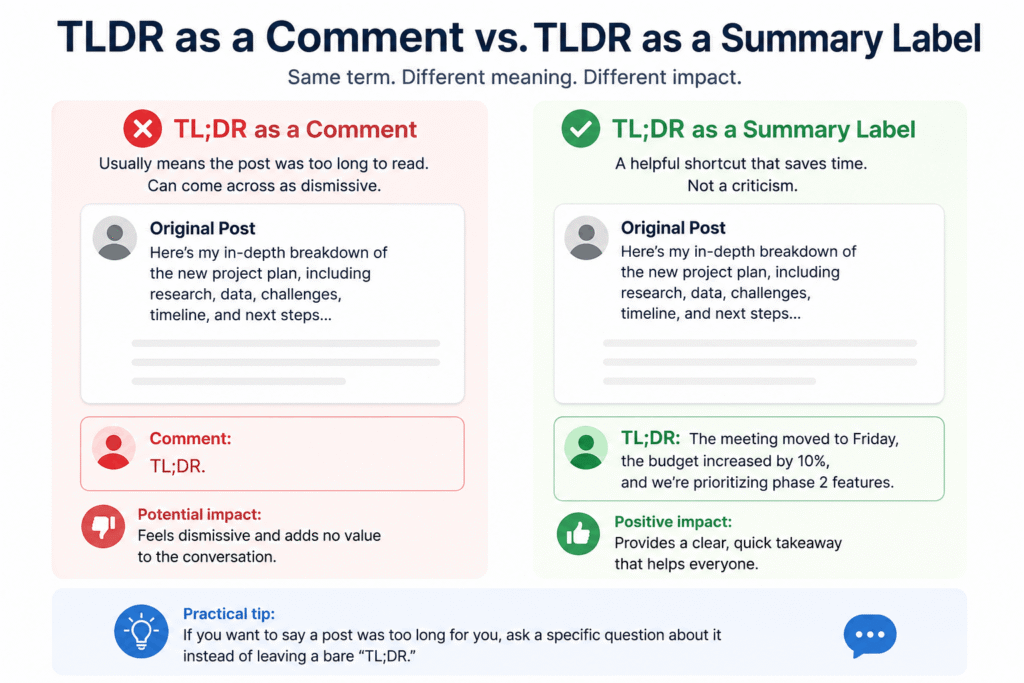
Why it works: as a standalone comment, “TL;DR.” usually means the original post was too long to read, which can come across as dismissive. As a label attached to a short summary, such as “TL;DR: the meeting moved to Friday,” it is simply a helpful shortcut, not a criticism.
Who should skip this: if you’re replying with a bare “TL;DR” and nothing else, consider whether it reads as a genuine time constraint or as a dismissive jab, since tone depends heavily on context here.
Practical tip: if you want to signal “this was too long for me” without sounding rude, pair it with a specific question about the post instead of leaving it as a standalone comment.
Common Mistakes People Make With TLDR
- Writing a TLDR that is vague or teasing instead of stating the actual point.
- Using TLDR in a formal document, academic paper, or job application, where it reads as too casual.
- Assuming “TL;DR” and “TLDR” are different terms. They are the same abbreviation, just punctuated differently.
- Confusing TLDR with BLUF. Both introduce a summary, but BLUF fits formal or professional writing better.
- Making the TLDR longer than the sections it is meant to summarize.
Frequently Asked Questions
What does TLDR mean?
TLDR stands for “too long; didn’t read.” It flags a lengthy piece of text and usually introduces a short summary of it.
Is TLDR rude?
It can come across that way, since it started as a dismissive comment on overly long posts. Today it is mostly used as a neutral or helpful summary label rather than an insult.
Is TL;DR a real word?
Yes, TL;DR is an established dictionary entry. Merriam-Webster lists it as both an interjection and a noun.
What is the difference between TL;DR and TLDR?
None. They are the same term, with ‘TL;DR’ being the traditional punctuated form and “TLDR” the shortened version without the semicolon.
Should I use TLDR in a work email?
It can work in casual internal emails, especially long ones with several points, but it is best avoided in formal or external business communication.
Where do you put TLDR, at the top or bottom?
Either works. The top suits posts written for skimmers who want the conclusion first. The bottom suits posts where readers are expected to follow the full explanation before the recap.
What does TLDR mean on Reddit?
On Reddit, TL;DR is commonly added to a long post or comment to summarize the main point for readers who want the gist without reading everything.
What is the difference between TLDR and BLUF?
Both introduce a short summary, but BLUF is generally used in structured business or military writing, while TLDR is casual, internet-native shorthand.
Final Recommendation
If you are writing a casual, long post or email, a short TL;DR at the top or bottom most likely helps your reader. If you are writing something formal, an abstract or executive summary is the better fit, and TLDR is best left out entirely.
Conclusion
TLDR started as a blunt internet comment and evolved into a genuinely useful summary tool with an established dictionary entry. The part worth remembering is simple: use it to save your reader time with a real summary, not a vague teaser, and skip it in formal writing.
Sources
- Merriam-Webster, “TL;DR” dictionary entry, for the definition, parts of speech, and the dictionary’s own note tracing first recorded use to 2002
- CBS News, “‘Hangry’ And ‘TL;DR’ Among More Than 800 New Words Added To Merriam-Webster Dictionary,” confirming TL;DR as part of that 2018 batch of 840 new entries
- How-To Geek, “What Does ‘TLDR’ Mean, and How Do You Use It?”, which explicitly notes the exact originating forum is unconfirmed rather than presenting one as settled fact